Airdoctor AD1000 Review: UltraHEPA Power for Small Spaces
The Airdoctor AD1000 is a compact air purifier featuring a powerful UltraHEPA filter for capturing ultra-fine particles, ideal for bedrooms and home offices with its quiet auto mode.
 By admin
Updated October 19, 2026
Quick Verdict
8.6/10Designed for smaller spaces like guest rooms and home offices, the AirDoctor AD1000 features an UltraHEPA filter that captures particles far smaller than standard. Its auto mode adjusts purification based on real-time air quality, operating quietly.
What we like
- Powerful UltraHEPA filter captures particles as small as 0.003 microns
- Effective auto mode with air quality sensors for hands-off operation
- Quiet operation, especially praised in customer reviews for bedrooms
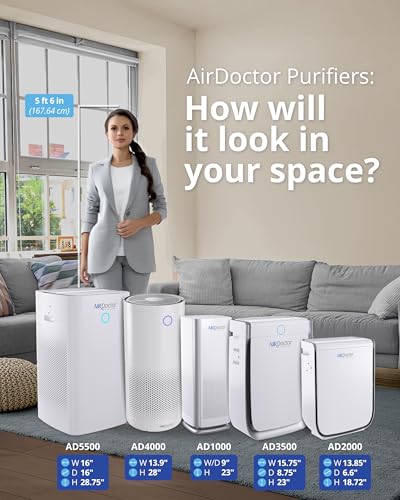
- Compact design suitable for small to medium-sized rooms
Watch out for
- Filter compatibility is limited to proprietary AirDoctor replacements
- Designed for smaller spaces, not for large, open floor plans
For those seeking cleaner air in specific, smaller rooms of their home, the Airdoctor AD1000 presents a focused solution. Marketed as perfect for guest rooms, kids’ bedrooms, and home offices, this HEPA air purifier is engineered to provide high-performance filtration in spaces up to 285 square feet. At its core is an UltraHEPA filter that claims to capture particles far smaller than the standard HEPA benchmark, paired with smart sensors for automatic operation.

This review analyzes the Airdoctor AD1000’s specifications, design, and owner feedback to determine if its targeted approach to air purification delivers on its promises. Bottom line: The Airdoctor AD1000 is a compelling option for allergy sufferers and anyone prioritizing ultra-fine particle removal in compact living or working spaces, thanks to its advanced filter technology and set-and-forget auto mode.
Prime AirDoctor AD1000 HEPA Air Purifier for Rooms up



As an Amazon Associate we earn from qualifying purchases. Product prices and availability are accurate as of the date/time indicated.
Airdoctor AD1000 at a Glance
| Specification | Detail |
|---|---|
| Model | Airdoctor AD1000 |
| Filtration Stages | 3-stage (Pre-filter, UltraHEPA, Carbon VOC) |
| Filter Performance | Captures particles as small as 0.003 microns |
| Room Coverage | 285 sq. ft. (4x/hour) or 570 sq. ft. (2x/hour) |
| Key Feature | Auto Mode with Air Quality Sensors |
| Fan Speeds | 4, including a Whisper-jet fan design |
| Noise Level | Reported as 30% quieter than traditional purifiers |
| Design | Sleek tower, white color |
| Weight | 3.33 kg |
| Included Filters | 1 UltraHEPA filter, 1 Carbon VOC filter |
Design and Build
The Airdoctor AD1000 is described as a sleek tower air purifier with a white finish, designed to fit discreetly into a room’s decor. Its compact form factor is a direct result of its intended use for smaller spaces like bedrooms and offices. The unit has a stated weight of 3.33 kilograms, suggesting it is relatively lightweight and portable for moving between rooms as needed. The overall build appears focused on functional, space-efficient purification rather than occupying a large footprint. The control interface, while not described in granular detail in the provided data, facilitates access to its key features including the four fan speeds and the pivotal auto mode.
Performance and Features
UltraHEPA and 3-Stage Filtration
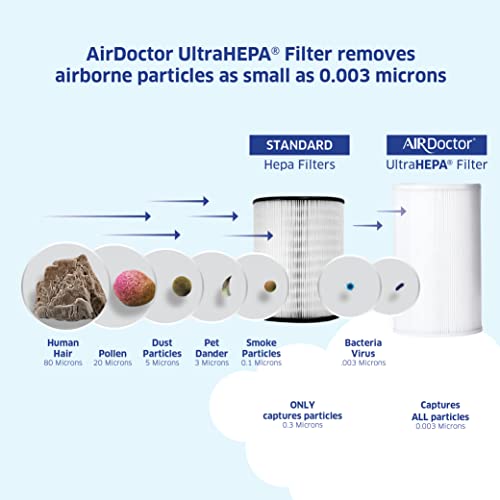
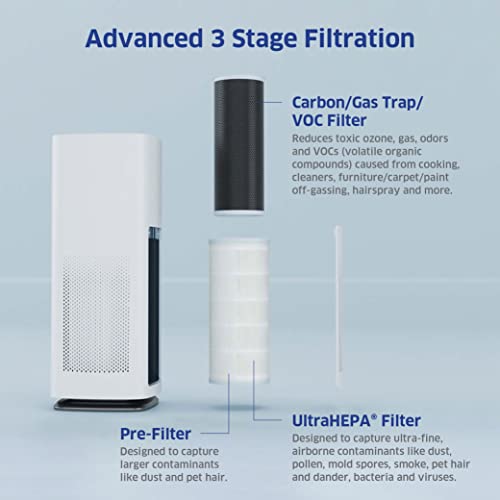
The standout performance claim of the AD1000 is its UltraHEPA filter. The manufacturer states it is independently tested to capture airborne particles as small as 0.003 microns in size, which is noted as being 100 times smaller than the standard HEPA benchmark. This forms the second stage of a three-stage filtration system. The first stage is a pre-filter for larger particles, and the third is a proprietary dual-action Carbon VOC filter designed to capture volatile organic compounds and odors, such as formaldehyde. This combination aims to address a wide spectrum of pollutants, from allergens and pet dander to chemical vapors.
Room Coverage and Air Changes
The Airdoctor AD1000 is engineered for smaller spaces. Its rated coverage is for rooms up to 285 square feet, where it can circulate the air four times per hour. For larger rooms up to 570 square feet, it provides two air changes per hour. This makes it suitable for the target applications like small bedrooms, nurseries, home offices, and laundry rooms, but not for large, open floor plans. Understanding the best air purifier location can help maximize its effectiveness in these designated spaces.
Auto Mode and Controls
A significant feature highlighted is the auto mode, which uses built-in air quality sensors to adjust the fan speed and filtration level automatically based on real-time conditions. This allows for hands-off operation, a benefit frequently mentioned in owner reviews. The unit offers four manual fan speeds, giving users customization from a reported “whisper quiet” setting to a “boost” mode for rapid purification. The Whisper-jet fan technology is claimed to make the unit 30% quieter than traditional air purifiers, which is critical for use in bedrooms and offices where noise can be disruptive.
Maintenance and Running Costs
Maintenance for the Airdoctor AD1000 revolves around its filter replacements. The unit comes with one UltraHEPA filter and one Carbon VOC filter included. A key point from the manufacturer is that the AD1000 is only compatible with proprietary UltraHEPA and Carbon VOC filters made by Airdoctor. This means owners must purchase replacement filters directly from the brand. The specific cost and recommended replacement interval for these filters are not detailed in the provided data, so prospective buyers should factor in this ongoing cost. General upkeep would involve periodically checking and cleaning the reusable pre-filter, if applicable, as per the user manual.
What Owners Say
Owner feedback for the Airdoctor AD1000 is overwhelmingly positive, reflected in its high average rating. The distribution shows a significant majority of perfect scores, with a smaller proportion of lower ratings. Reviewers with allergies and pets praise its effectiveness, with some stating their allergy symptoms have reduced or vanished. The auto mode is frequently highlighted as a “life-saver” for its convenience and effective response to air quality changes. Many owners specifically commend its quiet operation, especially in auto mode during nighttime use in bedrooms, noting less stuffiness in the morning. Some comparisons from owners who have tried other major brands claim the AD1000 outperforms them, a sentiment supported by their own experience and air quality monitors. This aligns with the goal of a purifier effective against fine dust and allergens.
Pros and Cons
Pros
- UltraHEPA filter captures particles as small as 0.003 microns
- Effective auto mode with responsive air quality sensors
- Quiet operation, particularly on lower and auto settings
- Compact, tower design suitable for small to medium rooms
- Three-stage filtration tackles allergens, dander, and VOCs
- Highly rated by owners for allergy and pet household relief
Cons
- Requires proprietary Airdoctor brand replacement filters
- Designed for smaller spaces, not for large or open areas
- Specific filter lifespan and cost data not provided in specs
- Limited compatibility with third-party filter options
Who Should Buy It (and Who Should Skip It)
The Airdoctor AD1000 is an excellent choice for individuals with allergies, asthma, or sensitivity to airborne particles who need to purify the air in a specific, contained room. It’s ideal for a bedroom, home office, nursery, or guest room up to 285 square feet. Pet owners struggling with dander will also find its filtration claims compelling. Those who value a “set it and forget it” appliance will appreciate the effective auto mode. It’s also a good fit for anyone seeking a quiet purifier for nighttime use or focused work environments.
Conversely, you should skip the Airdoctor AD1000 if your primary goal is to clean the air in a large living room, open-concept area, or entire apartment. Its coverage is engineered for smaller, defined spaces. Budget-conscious buyers wary of potential long-term costs should seek clarification on filter replacement pricing before purchasing, as the unit mandates brand-specific filters. Those who prefer universal filter compatibility or need a purifier for a large space should consider other models designed for greater square footage.
Final Verdict
The Airdoctor AD1000 carves out a strong niche in the air purifier market by focusing on advanced filtration for compact spaces. Its claim of capturing ultra-fine particles down to 0.003 microns with its UltraHEPA filter is its most significant technical advantage, offering a level of purification that exceeds standard HEPA units. When combined with a carbon filter for gases and the convenience of an auto mode that actually works according to users, it presents a robust package for its intended use cases. The glowing owner reviews, particularly from allergy and pet owners, provide real-world validation of its performance claims in bedrooms and home offices.
While the dependency on proprietary filters is a consideration, and its coverage limits its application, the AD1000 excels precisely where it is designed to: delivering powerful, quiet, and automated air cleaning for rooms up to 285 square feet. For anyone looking to significantly improve air quality in a key room like a bedroom or office, especially to combat allergens or pet dander, the Airdoctor AD1000 is a top-tier contender that warrants serious consideration. Its performance is akin to what one might seek in a specialized purifier for germs and microbes, but for a residential setting.
FAQs
How small of particles can the Airdoctor AD1000 filter capture?
The manufacturer states the UltraHEPA filter in the AD1000 is independently tested to capture airborne particles as small as 0.003 microns in size. This is significantly smaller than the 0.3-micron particle size used for the standard HEPA test, which the brand notes is “100 times smaller than the HEPA standard.” This includes many ultra-fine allergens, smoke particles, and some viruses.
Is the Airdoctor AD1000 good for pet allergies?
Yes, based on the product specifications and owner reviews, it is well-suited for pet allergies. The three-stage filtration is designed to capture pet dander, and the UltraHEPA filter targets the very small particles associated with it. Numerous reviews from pet owners specifically credit the AD1000 with reducing their allergy symptoms and improving air quality in homes with dogs, cats, and even birds.
Can I use the AD1000 in a large living room?
The Airdoctor AD1000 is engineered for smaller spaces. Its optimal coverage is for rooms up to 285 square feet, where it can provide four air changes per hour. For a room up to 570 square feet, it will provide two air changes per hour, which may be sufficient for some. However, for large, open-plan living areas significantly beyond this size, a purifier with a higher Clean Air Delivery Rate (CADR) and coverage rating would be more appropriate. The manufacturer recommends it for small bedrooms, home offices, and similar-sized rooms.
How loud is the Airdoctor AD1000 on auto mode?
According to the manufacturer, the Whisper-jet fans in the AD1000 are 30% quieter than traditional air purifiers. Owner reviews consistently describe the unit as “pretty quiet” or “whisper quiet” when operating in auto mode, especially at night. This makes it suitable for bedrooms and home offices where noise can be a distraction. The noise level will increase on the higher manual fan speeds, such as the “boost” setting, during intense purification cycles.
Featured In
About the author

admin writes reviews and buying guides for LAT Review.