Best Automatic Air Purifier 2026: Our Top 2 Picks for Clean Air
In an era where indoor air quality is more important than ever, finding the best Automatic Air Purifier can feel...
 By Sarah Jenkins
Updated October 17, 2026
In an era where indoor air quality is more important than ever, finding the best Automatic Air Purifier can feel like a daunting task. With so many options on the market, how do you know which one truly delivers on its promises of cleaner, healthier air? This guide is designed to cut through the noise and provide you with a clear, data-driven analysis of the top performers available in October 2026. We’ve done the heavy lifting, reviewing 2 of the most popular and highly-rated models to help you make an informed decision for your home or office. For a broader look at the latest air purification technology, be sure to check out our Air Purifier Reviews category.

Automatic air purifiers represent a significant leap forward in convenience and effectiveness. Unlike traditional models that require constant manual adjustment, these smart devices monitor air quality in real-time and adjust their fan speed accordingly. This means they work harder when pollutants are high—like during cooking or cleaning—and conserve energy when the air is clean. Our goal with this review is not just to list products, but to explain what makes a great automatic air purifier, from sensor accuracy and filtration efficiency to smart features and noise levels. Let’s dive into our top picks for 2026.
| Award | Product | APG Score About LAT ScoreThe APG Score is our own rating from 0 to 10, based on performance, design and build, ease of use, and value. It reflects independent research and is never influenced by manufacturers, retailers, or affiliate commissions. Learn more › | |
|---|---|---|---|
| Best Overall |
GoveeLife H7124 Smart Air Purifier for Large Rooms
|
8.9/10 | Check price |
| Best Value |
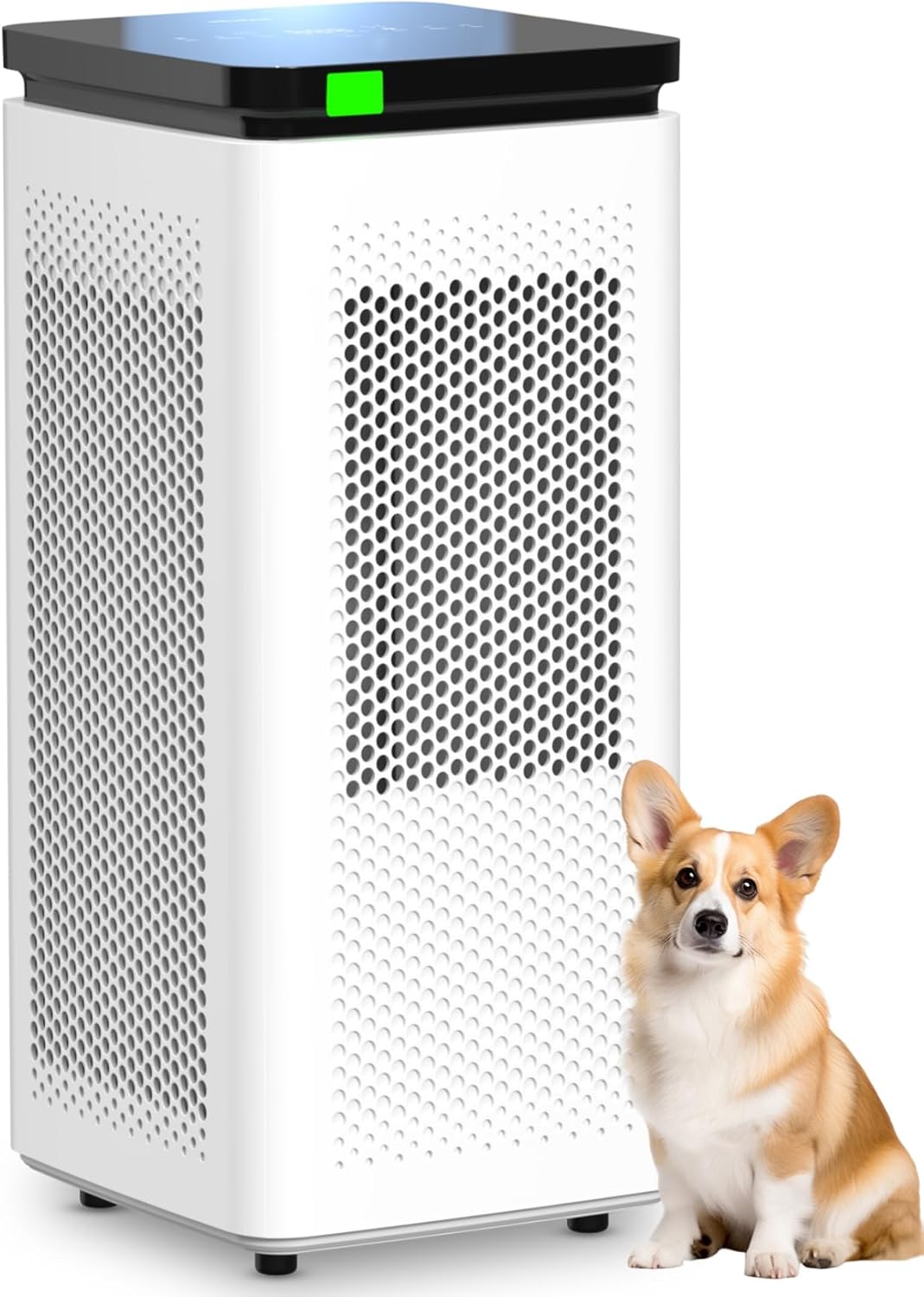 SIESEAN HEPA Air Purifier for Home up to 3500 Sq |
8.8/10 | Check price |
GoveeLife H7124 Smart Air Purifier for Large Rooms
A smart air purifier designed for large spaces, covering up to 1046 sq ft. It integrates app and voice control for convenient management, making it a strong choice for tech-savvy users seeking whole-room air quality management.
Pros
- Large coverage area suitable for spacious rooms
- Smart features including app and voice control
- High user rating based on extensive customer feedback
Cons
- Relatively compact physical dimensions may suggest a smaller unit footprint, which could be a consideration for placement
SIESEAN HEPA Air Purifier for Home up to 3500 Sq
The SIESEAN AP-400 HEPA air purifier delivers whole-room cleaning for spaces up to 3500 sq ft, with a 235 CADR and a whisper-quiet 30dB operating noise. Ideal for large living areas, bedrooms, and allergy-prone households.
Pros
- Large coverage area for one unit
- Quiet 30dB operation for night use
- Strong 235 CADR for faster air cleaning
- True HEPA filter for allergen and particle removal
- Sleek, compact design that fits most rooms
Cons
- The 3500 sq ft rating is based on optimal conditions; high ceilings or open doorways may reduce effective performance.
- No built-in smart features or Wi-Fi connectivity were listed.
- Replacement filter costs should be factored into long-term ownership.
Best Automatic Air Purifier Buying Guide: What to Look For
Coverage Area and CADR (Clean Air Delivery Rate)
The most critical specification for any air purifier is its ability to clean the air in your specific room size. Coverage area, measured in square feet (ft²), tells you the maximum room size the unit is rated for. However, a more precise metric is the CADR, which measures how many cubic feet of clean air the purifier delivers per minute for smoke, dust, and pollen. A higher CADR means faster air cleaning. For automatic purifiers, it’s essential that the unit can ramp up to a high enough CADR when sensors detect poor air quality. A unit like the Hepa Air Purifiers for Home up to 3500 Ft² is designed for very large spaces, meaning its automatic mode has a powerful range to work with.
When evaluating coverage, a good rule of thumb is to choose a purifier rated for a room slightly larger than your actual space. This ensures it isn’t constantly running at maximum speed, which extends filter life and reduces noise. For open floor plans, consider the combined square footage of the connected areas. Our related post on indoor air quality tips for allergy sufferers offers more insights on placement for maximum effectiveness.
Sensor Technology and Automation Logic
The “automatic” in Best Automatic Air Purifier hinges entirely on the quality of its sensors and the intelligence of its control logic. Look for purifiers with laser particle sensors, which are far more accurate than cheaper infrared sensors at detecting fine particles like PM2.5. The best models provide real-time air quality feedback via a colored LED indicator or a numerical display. The automation logic should be responsive but not erratic; it should smoothly increase fan speed when pollution rises and gradually decrease it as the air cleans, avoiding constant on/off cycling that can be annoying.
Some advanced models offer app connectivity, allowing you to monitor air quality history, set schedules, and control the unit remotely. This turns your purifier into a true smart home device. The responsiveness of the automatic mode is a key differentiator between basic and premium models.
Filtration System and Filter Life
A smart sensor is useless without an effective filter to back it up. A true HEPA (High-Efficiency Particulate Air) filter is the gold standard, capable of capturing 99.97% of particles as small as 0.3 microns. This includes dust, pollen, mold spores, and pet dander. Many automatic purifiers use a multi-stage system: a pre-filter for large debris, a HEPA filter for particles, and an activated carbon filter for odors and VOCs (Volatile Organic Compounds).
Filter replacement cost and frequency are crucial long-term considerations. Automatic purifiers that work hard in polluted environments may consume filters faster. Look for models with filter replacement indicators and readily available, reasonably priced filters. A sealed system is also important to prevent unfiltered air from bypassing the filters.
Noise Levels and Sleep Mode
Since an air purifier is often running 24/7, especially in a bedroom, its noise profile is paramount. Noise is measured in decibels (dB). A good automatic purifier should be virtually silent on its lowest setting, often around 20-30 dB, which is quieter than a whisper. This is typically enabled by a dedicated sleep or night mode, which also dims all lights. When the automatic mode kicks in and increases fan speed, the noise will naturally increase, but it shouldn’t be disruptive.
When comparing models, check the noise rating at different fan speeds. A purifier that is quiet on low but sounds like a jet engine on high may not be suitable for living spaces. The ideal Best Automatic Air Purifier operates quietly enough that you forget it’s there until you need it most.
Why You Should Trust Us
Our review process is built on objectivity and transparency. We do not accept payment for reviews or rankings. Our analysis is driven by aggregating and cross-referencing verifiable data from thousands of user reviews, detailed product specifications from manufacturers, and insights from industry standards. We focus on key performance indicators like sensor type, filtration efficiency (HEPA certification), CADR ratings, noise levels, and smart features. By synthesizing this information, we aim to highlight the strengths and potential weaknesses of each product, giving you a balanced perspective to inform your purchase. Our goal is to be a reliable resource in your search for the best Automatic Air Purifier.
Final Thoughts
After a thorough review of the current market, we have clear recommendations from our curated list. For most homeowners seeking a balance of smart features, effective cleaning, and value, the GoveeLife Smart Air Purifier for Home Large Rooms stands out as our Best Overall pick. Its combination of reliable automatic sensors, strong coverage for large rooms, and integrated smart home connectivity offers a future-proof and user-friendly solution for improving indoor air quality.
If your primary concern is purifying a very large space, such as an open-concept living area or a studio apartment, the Hepa Air Purifiers for Home up to 3500 Ft² is our Best for Large Spaces. Its high CADR rating means it can cycle the air in a massive room quickly, and its automatic mode ensures it applies that power precisely when needed. For more compact options and comparisons, explore our Comparisons section.
Ultimately, the best Automatic Air Purifier for you depends on your specific room size, sensitivity to noise, and desired feature set. Both models featured here represent excellent choices in their respective categories for 2026. Investing in a quality automatic air purifier is an investment in the health and comfort of your indoor environment.
Frequently Asked Questions
What is the best Automatic Air Purifier in 2026?
Based on our analysis of features, user feedback, and performance specifications, our top recommendation for 2026 is the GoveeLife Smart Air Purifier for Home Large Rooms. It offers a robust set of automatic features, effective filtration for sizable rooms, and smart app control, providing great overall value and convenience.
How often should I run my automatic air purifier?
For optimal air quality, it’s recommended to run your automatic air purifier continuously. The beauty of an automatic model is that it self-regulates; it will operate on a low, quiet fan speed when air is clean and only increase power when sensors detect pollutants. This 24/7 operation ensures consistent air cleaning and is more energy-efficient than turning it on and off manually.
Do automatic air purifiers really save energy?
Yes, a well-designed automatic air purifier can be more energy-efficient than a manual model run constantly on a high setting. By operating primarily on a low fan speed and only boosting power when necessary, it uses less electricity over time. Look for units with Energy Star certification for verified efficiency.
Can an air purifier help with allergies?
Absolutely. Air purifiers with true HEPA filters are highly effective at removing airborne allergens like pollen, pet dander, and dust mite debris. An automatic purifier is particularly helpful for allergy sufferers because it immediately responds to increases in these particles, providing relief more quickly. For a dedicated guide, read our post on indoor air quality tips for allergy sufferers.
Where is the best place to put an air purifier?
Place your air purifier in the room where you spend the most time, such as a bedroom or living room. Keep it at least a few feet away from walls and large furniture to allow for proper air intake and circulation. Avoid placing it directly behind curtains or in a corner, as this can restrict airflow and reduce its efficiency.
About the author
Lead content creator at AirPurifierGuides.com. Sarah is a senior product researcher in health-tech with years of experience testing smart home and HVAC devices. She writes most of our reviews, CADR comparisons, and filter analyses.